

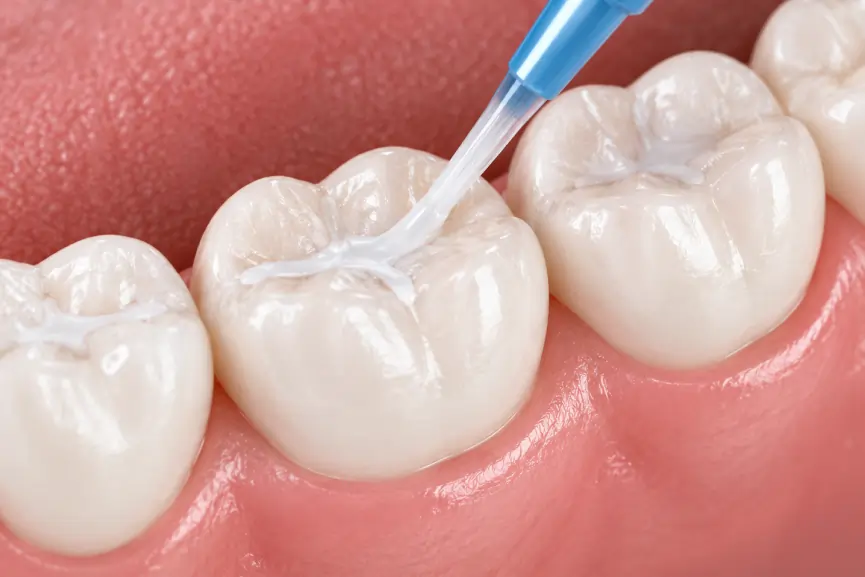
What Are Dental Sealants?
Dental sealants are thin plastic coatings bonded to the chewing surfaces of the molars and premolars. These are the back teeth you chew with.
Back teeth have pits and grooves called fissures. Food and bacteria settle in them, and toothbrush bristles cannot reach the bottom. A sealant fills those grooves and leaves a smooth surface that is easy to clean.
Sealants do not replace brushing, flossing, dental exams or cleanings. They add one more layer of protection to the teeth most likely to trap food and plaque.
What Do Dental Sealants Do?
Dental sealants keep food, plaque and bacteria out of the grooves on back teeth, so decay has less chance to start there. A 2017 Cochrane review of 38 trials found that resin sealants prevent decay in the first permanent molars of children aged 5 to 10.
Sealants help to:
- ✓Lower cavity risk in molars and premolars
- ✓Protect deep grooves that are hard to clean
- ✓Prevent cavities in children and teens
- ✓Add protection for patients with a history of cavities
A sealant works on a healthy tooth or a tooth at risk. A tooth that already has a cavity needs a filling instead.
Who May Need Dental Sealants?
Children and teens are the main group, because their new permanent molars are prone to cavities in the first years after they come in. Adults with deep grooves and no decay in those teeth are candidates too.
Your dentist may recommend sealants for:
Your dentist checks each tooth surface and your cavity risk before recommending sealants. The Canadian Dental Association supports sealants chosen this way, tooth by tooth.
- ✓Children whose permanent molars have just come in
- ✓Teens with deep grooves in their back teeth
- ✓Patients who find their molars hard to clean
- ✓Patients with a history of cavities
- ✓Back teeth that trap food
Dental Sealants for Children: At What Age?
The right time to seal a permanent molar is soon after it comes in, before decay has a chance to start. First permanent molars come in between ages 5 and 7. Second molars follow between ages 11 and 14. Those are the ages the NIDCR gives in its fact sheet for parents.
That puts the first sealant visit for most children around age 6 and the second around age 12. Your child's dentist looks at the grooves and cavity history at each checkup and tells you when a tooth is ready.
Baby teeth with deep pits and grooves are candidates as well. The Canadian Dental Association supports sealants on both baby and permanent teeth when a child's cavity risk calls for it.
Sealants fit into a child's preventive plan with exams, cleanings, fluoride and good brushing at home. Our children's dentistry page covers the rest of that plan.
Do Adults Need Dental Sealants?
Some do. An adult with deep grooves in a back tooth that has no decay and no filling on the chewing surface can have that tooth sealed. A history of cavities is a good reason to ask.
Sealants do not go on a chewing surface that already has a filling. A cavity on that surface needs a dental filling instead.
What to Expect During Dental Sealant Treatment
Tooth Check
The dentist or hygienist checks the back teeth to see whether sealants are suitable.
Tooth Cleaning
The chewing surface is cleaned so the sealant can bond properly.
Tooth Preparation
The tooth surface is prepared so the sealant grips, then kept dry during placement.
Sealant Application
The sealant material is painted into the grooves of the tooth as a liquid.
Hardening the Sealant
The sealant hardens into a protective coating over the chewing surface.
Bite Check
Your bite is checked so the sealed tooth feels comfortable.
Dental Sealants vs Fluoride Treatment
Dental sealants and fluoride treatment both lower cavity risk. They work in different ways.
Dental sealants protect the chewing grooves of back teeth by covering the pits and fissures where food and bacteria collect.
Fluoride treatment strengthens enamel across all your teeth and makes it more resistant to acid. A child can have both. Your dentist recommends one, the other or both based on age, tooth shape and cavity risk.
Can Sealants Be Placed Over Cavities?
Sealants go on healthy teeth and on very early decay that has not yet formed a hole. The American Dental Association says a sealant placed over early decay helps stop further damage to the tooth.
A tooth with a real cavity is different. It needs a filling. This is why the tooth check comes first: it decides whether a tooth gets a sealant or another treatment.
How Long Do Dental Sealants Last?
Dental sealants last up to 10 years, according to the NIDCR. They wear, chip or come loose over time, more so on teeth that do heavy chewing.
The Cochrane review found the protection held at four years of follow-up. Beyond four years the research is thinner.
Your dentist checks your sealants at each dental exam. A worn or chipped sealant is repaired by adding more material, or it is replaced.
Cost and CDCP Information
The cost of dental sealants depends on how many teeth are sealed and on your dental coverage. Sealants are billed per tooth, and an exam or cleaning at the same visit is a separate item.
We do not publish a general Ontario price for sealants. The cost guides we checked disagreed too much to give you a useful range. We explain the expected cost before treatment begins.
Grimsby Lake Dental accepts CDCP and bills the plan directly for eligible services. The CDCP Dental Benefits Guide covers sealants on eligible permanent back teeth for patients 17 and under. Our CDCP page explains who qualifies and what you pay.
If you have private insurance or another dental benefit, bring your plan details to your visit. Our team reviews the estimated cost with you before treatment begins.
Related Services
Good to know
Frequently Asked Questions
Who should get dental sealants?+
Children and teens with newly erupted permanent molars are the main group. Adults with deep grooves and no decay in those teeth can benefit too.
At what age should a child get dental sealants?+
Soon after the permanent molars come in. That is between ages 5 and 7 for the first molars and between 11 and 14 for the second molars.
Do dental sealants prevent cavities?+
Yes. Sealants lower cavity risk on the chewing surfaces of molars and premolars by covering the grooves where food and bacteria collect.
Do sealants replace brushing and flossing?+
No. Sealants add a layer of protection. You still need brushing, flossing, dental exams and cleanings.
What is the difference between sealants and fluoride?+
Sealants protect the grooves on back teeth. Fluoride strengthens enamel across all your teeth. Some patients benefit from both.
Can sealants be placed on teeth with cavities?+
Not on a real cavity. That tooth needs a filling. A sealant can cover very early decay that has not formed a hole, and your dentist checks the tooth first.
How long do dental sealants last?+
Up to 10 years. They wear or come loose over time, so your dentist checks them at each exam and repairs them when needed.
Do dental sealants contain BPA?+
Sealants can contain trace amounts of BPA left from making the resin. The American Dental Association says the small rise in saliva clears within about 24 to 48 hours.
Does CDCP cover dental sealants?+
Yes, for eligible patients 17 and under, on eligible permanent back teeth. Our CDCP page explains who qualifies.
Where is Grimsby Lake Dental located?+
Grimsby Lake Dental is at 414 Winston Rd, Grimsby, ON L3M 0H2, near Lake Ontario and the QEW. Parking on site is free.
Book Dental Sealants in Grimsby
Want to know if sealants are right for you or your child? Book a preventive dental visit at Grimsby Lake Dental. If you are searching for dental sealants near you in Beamsville, Lincoln, Vineland or Winona, we are a short drive away on Winston Road. We are open Monday to Saturday, with Saturday appointments from 8:00 AM to 2:00 PM.