

What you pay depends on your family income, the service and the plan's rules. This guide lays out what the government lists and what needs approval first. Grimsby Lake Dental in Grimsby, Ontario accepts CDCP for eligible patients and eligible services.
Key takeaways
- CDCP is a federal plan for people with no access to dental insurance. The Government of Canada decides who qualifies, not the clinic
- The plan pays a share set by income. Below $70,000 it pays 100% of its fee. The next two bands pay 60% and 40%
- The list is wide. It names exams, X-rays, cleanings, fillings, root canals, dentures and tooth removal
- Some services need approval first. Crowns are one. So is any service past the frequency limits
- Orthodontic services are currently not available. Cosmetic work such as whitening and veneers is a separate question
What is the CDCP and who can use it?
The CDCP is a Government of Canada dental plan for residents who have no access to dental insurance. Access counts if it comes through a health spending account, an employer or pension plan (yours or a family member's), or insurance that you or a family member bought. It is not a private policy, and your dentist does not approve or deny your application.
You need to be a resident of Canada for tax purposes, and you and your spouse or common-law partner must have filed taxes. Your adjusted family net income must be under $90,000. The plan is open to all ages, children included.
Not sure where you stand? Check the official federal page before you book it. A clinic cannot tell you that you qualify.
What does the CDCP cover?
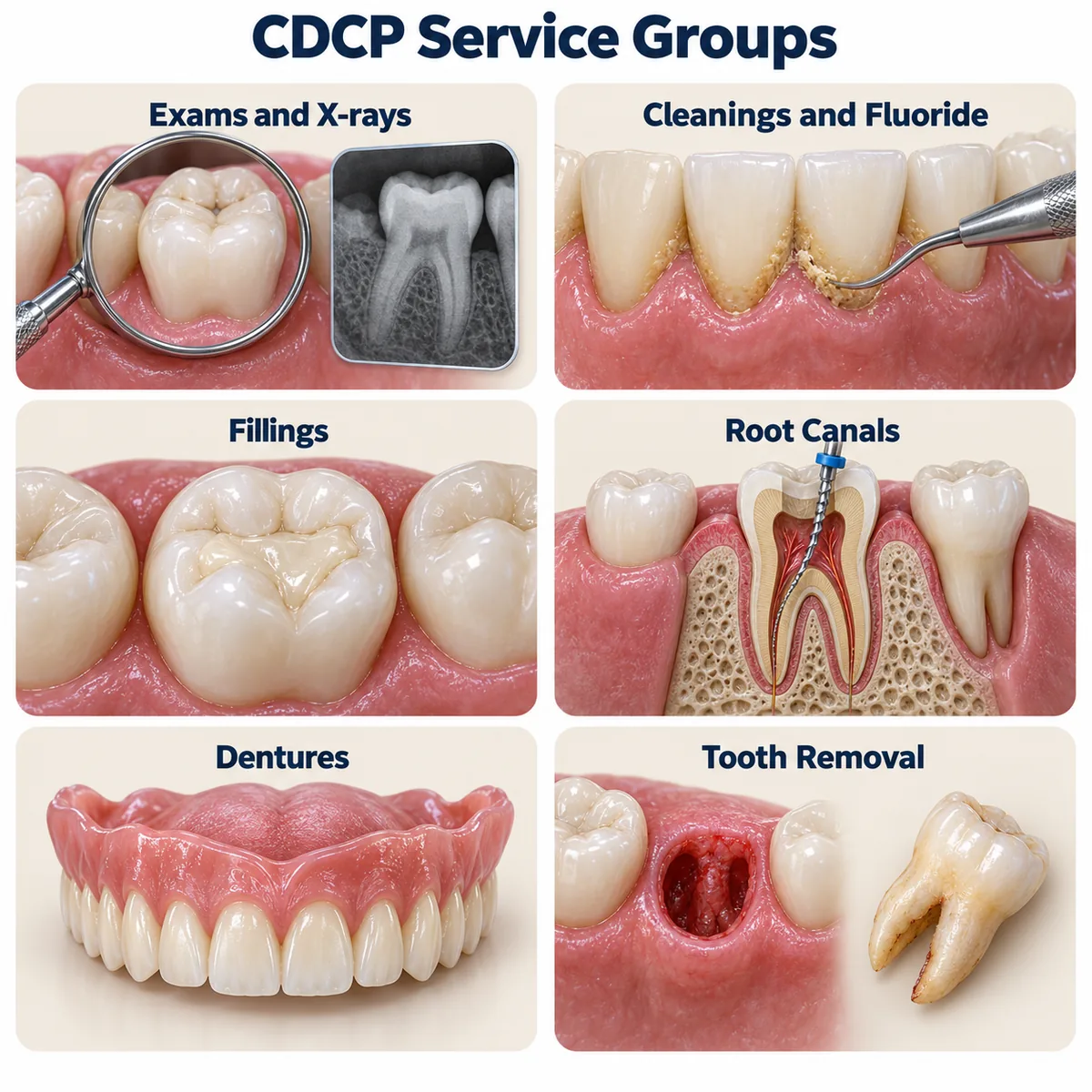
The federal coverage page says the plan "will help pay a portion of the cost for a wide range of oral health care services." You can read the full list on the Government of Canada CDCP coverage page.
In plain words, the list includes:
- Exams, including emergency exams, and X-rays.
- Cleaning (scaling), fluoride and sealants.
- Permanent and temporary fillings.
- Root canal treatment and cleaning under the gumline.
- Complete dentures and denture repairs.
- Removal of teeth and roots.
- Nitrous oxide and oral sedation.
Each line carries a limit on how many times you can have the service and your case also has to meet the plan's criteria. Emergency exams are on the coverage list. The plan can help with eligible urgent care. For children it can help with eligible exams, cleanings, fluoride, sealants and fillings. Our emergency dentistry page shows what to do for severe pain or a broken tooth, and our dental emergency post has the first steps.
A dental exam and checkup, a cleaning and a filling all sit on the list. So do root canal therapy, a tooth extraction and dentures.
How much will you pay?
The plan pays a share of the CDCP fee for each service. Your adjusted family net income sets that share. The government publishes three levels:
| Adjusted family net income | The plan pays | You pay |
|---|---|---|
| Below $70,000 | 100% of the CDCP fee | 0% |
| $70,000 to $79,999 | 60% of the CDCP fee | 40% |
| $80,000 to $89,999 | 40% of the CDCP fee | 60% |
The percentage applies to the CDCP fee, which is the fee the plan sets for that service. If the clinic's fee for the same service is higher, you pay the difference. A service the plan does not list is yours to pay in full.
So "100%" does not mean a bill of zero. CDCP is not always free, and you may have to pay fees on top of any co-payment. Our team can show you the likely gap before treatment starts.
What needs approval first?
Preauthorization is the plan's review of a proposed service before it is done. The government states that "some services including those beyond established frequency limits require preauthorization by the CDCP."
The coverage page lists several examples: crowns, cores and crown posts, complete immediate dentures, overdentures and partial dentures, and conscious or deep sedation. Bonding for mobile teeth, post-surgical evaluations and root canal re-treatment also need approval.
Approval is a coverage question only. Your dentist still recommends treatment on clinical grounds and the plan decides whether it will help pay. A denied request leaves you free to pay yourself or talk through other options with the team. Need a crown after a root canal? Ask the team to check for approval before the work is booked.
What does the CDCP leave out?
The federal page says "orthodontic services are currently not available." Braces and aligners sit outside the plan.
Cosmetic work is a different case. Services done mainly to change how teeth look are not a safe bet for coverage, and that group includes teeth whitening, cosmetic bonding and veneers. If a repair has a health reason, the plan's rules and your clinical need decide.
The government advises: "Before receiving oral health care, you should always ask your oral health provider about any costs that won't be covered by the plan."
What should you bring, and how does billing work?
Bring your CDCP coverage details, government-issued photo ID, any private insurance details, a list of your medications, your medical history, past X-rays and your questions about cost. For a child, bring the guardian and coverage information too.
Billing at our clinic runs in four steps and the team can walk you through each one:
- You book and the team confirms your coverage details where it can.
- The dentist examines you and recommends care.
- The team goes over estimated coverage and costs you may owe. Services that need approval go to the plan first.
- The clinic submits eligible claims. You pay any co-payment, extra charge or uncovered amount.
Frequently asked questions
What does the CDCP cover?
It helps pay for the services on the federal list. You pay a share set by your family income.
Is CDCP free dental care?
No. CDCP is not always free. At the lowest income level the plan pays all of its own fee, but you may have to pay extra fees, such as the gap to the clinic's fee and anything not listed.
Who can get the CDCP?
Residents of any age who have no access to dental insurance by any route, and whose family income falls under the $90,000 test. Tax filing and residency rules apply as well. The federal government decides.
Does the CDCP cover braces or aligners?
No. Orthodontic work is not available under the plan at this time.
Does the CDCP cover crowns?
Crowns are on the list but need approval from the plan first. Ask the team to check before yours is booked.
Does the CDCP cover whitening or veneers?
Work done mainly for looks is not a safe bet for coverage. Ask us about your case before booking.
Do you take CDCP patients at your Grimsby clinic?
Yes. The clinic at 414 Winston Road welcomes new patients and bills eligible services to the plan.